


Most People Buy Sunglasses Shaped Like the Model, Not Shaped Like Their Face
Lens shape, frame material, and fit do more for how sunglasses actually sit on your face than brand or trend ever will. Here's how to choose with your face shape in mind instead of a mood board.
Published Oct 22, 2026 — By Simone Halliday, Style Editor
Sunglasses fail for one of three reasons: the lens shape fights your face, the frame material is wrong for how you actually live, or the fit is off and nobody told you that's fixable. Trend has almost nothing to do with it. A pair that looked perfect in a campaign photo can look wrong the second it's on a different bone structure, and most people never figure out why, they just assume the sunglasses "don't suit them" and move on to the next pair that won't suit them either.
This is a decision-stage problem, not a browsing problem. You're not short on options, you're short on a method for picking between them.
What your face shape is actually telling you
Face shape isn't about vanity math, it's about contrast and proportion. The general rule eyewear stylists have used for decades: a frame should create a bit of contrast with your face's natural lines, not mirror them exactly.
- Round faces (soft angles, similar width and height) tend to look sharper in angular or geometric frames: square, rectangular, slight cat-eye.
- Square faces (strong jawline, wide forehead) usually soften nicely in round or oval lenses that break up the angles.
- Oval faces are the closest thing to a wildcard here; most shapes work, so the deciding factor becomes frame size relative to your features rather than shape at all.
- Heart-shaped faces (wider at the brow, narrower at the chin) generally balance out with bottom-heavy or slightly oversized frames that add visual weight lower down.
- Long faces benefit from frames with more depth than width, which keeps the eye from reading the face as even longer.
None of this is a hard law. It's a starting filter so you're not trying on forty pairs at random.
Frame material changes the fit more than people expect
The same lens shape in acetate, metal, or a lightweight composite will sit differently on your face, age differently, and suit a different kind of daily use.
| Material | Feel and durability | Best suited for |
|---|---|---|
| Acetate | Thicker, holds color and pattern well, slightly heavier | Bolder shapes, statement frames, everyday wear off the car |
| Metal (steel, titanium) | Slim profile, lighter, flexes less | Minimal and aviator-style shapes, frequent travel, pocket or bag storage |
| TR90/lightweight composite | Nearly weightless, very flexible | Sport use, kids, anyone who's broken acetate frames before |
| Mixed (acetate front, metal temple) | Balances weight and detail | People who want a statement front without the full weight |
Material also decides how the frame sits on your nose bridge and temples over a full day, which is the part people complain about later, not the shape they chose in the mirror.
Common mistakes people make when choosing sunglasses
Buying the shape that's trending, not the shape that fits. Oversized square frames look incredible on some faces and genuinely odd on others. A trend cycle doesn't know your bone structure.
Ignoring frame width entirely. The single most common fit failure isn't shape, it's width. A great shape in the wrong width looks either pinched at the temples or sits too wide and slides down. Check where the frame edge sits relative to your face's widest point, not just how the lens shape looks head-on.
Assuming metal means fragile. Quality metal frames, especially with spring hinges, often outlast acetate day to day. The fragile reputation comes from cheap thin metal, not metal as a category.
Treating lens color as purely cosmetic. Lens tint affects contrast perception and glare handling, not just the look. Gray lenses keep color accuracy true, brown and amber boost contrast in flat light, green sits in between. This matters if you're wearing them while driving or outdoors for hours, not just for a photo.
Not trying the nose bridge fit before judging the shape. A frame that slides down constantly will look wrong in every photo regardless of how correct the shape is for your face, because your head tilts to compensate.
Where the face-shape rule genuinely breaks down
Here's the honest limit of all of the above: face-shape matching is a styling heuristic, not a measurement. It assumes your face fits neatly into one of five categories, and most real faces are somewhere between two of them, or asymmetrical enough that the "rule" gives a wrong answer.
There's also a case where ignoring the rule entirely is the better move: when the sunglasses are doing a job other than flattering your face shape. Wraparound sport shapes exist for glare and peripheral coverage, not symmetry. Oversized frames in strong sun are chosen for coverage and UV protection first, flattery second. And a frame that's slightly "wrong" for your face shape but right for your personal style read, the way a heart-shaped face wears a narrow cat-eye against the rule and makes it work, can outperform the textbook-correct shape if you like wearing it. A frame you reach for every day beats a theoretically perfect frame sitting in a drawer.
So treat the face-shape guidance as the fastest way to narrow forty options down to six worth trying on, not as a rule that overrides your own read in the mirror.
How to pick a pair, step by step
1. Identify your face shape loosely, using a mirror and your jawline and forehead width as the main cues, not a precise geometric test.
2. Pick two or three contrasting shapes from the guidance above as your shortlist, not one single "correct" answer.
3. Decide what the glasses need to survive, daily carry in a bag, a desk, a car, kids, sport, and let that decide frame material before shape does.
4. Check width against your face at the widest point, in a mirror with the frame on, not just the shape silhouette.
5. Test the nose bridge fit by moving your head, nod and look down, if it slides immediately that frame is wrong regardless of how good the shape looks.
6. Pick lens tint for your actual use, gray for accuracy, brown or amber for contrast in flat or overcast light.
7. Only then weigh style and brand, once shape, material, and fit have already ruled out the pairs that wouldn't have worked anyway.
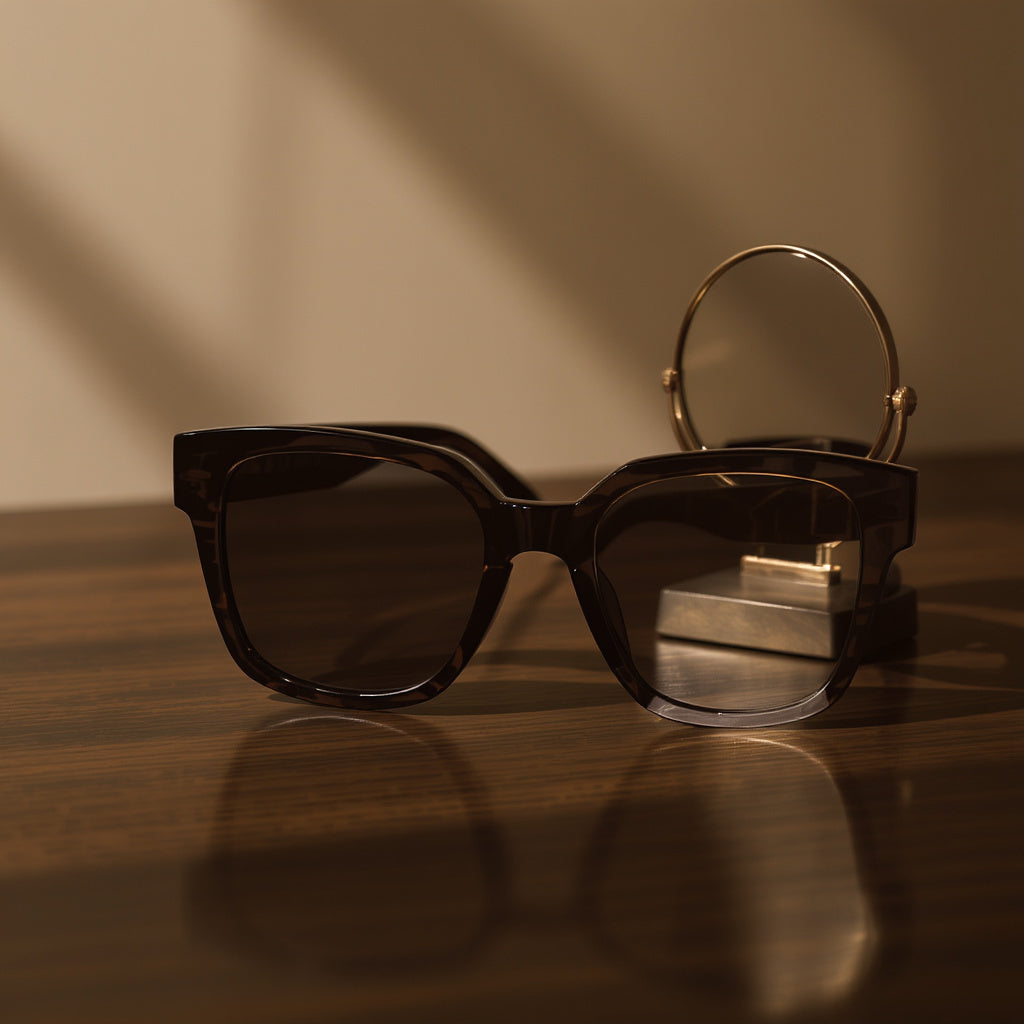
If you're shopping now, the CART Sunglasses are a useful example of this in practice: a frame silhouette built around that contrast principle rather than chasing a single seasonal shape, which is exactly the kind of pick that holds up past one summer.
Common questions
How do I know my face shape without going to an optician?
Pull your hair back, look straight into a mirror, and trace the outline of your face on the glass or a photo. Measure roughly: is your forehead wider than your jaw, is your face longer than it is wide, is your jawline sharp or soft. That's enough accuracy for choosing a shape; you don't need a professional measurement for this.
Are oversized sunglasses still a safe bet for most faces?
Oversized frames work on more face shapes than people assume because the size itself creates the contrast, but width still matters. Oversized and too wide for your face will slide and look ill-fitting regardless of the shape being flattering in theory.
Does frame color matter as much as frame shape?
Less than people think for fit, but it changes how noticeable the shape is. A black or tortoise frame in a bold shape reads calmer than the same shape in a bright color, which is worth knowing if you're nervous about trying a new silhouette.
Can I wear round sunglasses if I have a round face?
You can, but it's working against the contrast principle, so the round shape will tend to emphasize softness rather than add definition. It's not forbidden, it's just not the first thing to reach for if you want a sharper look.
What's the actual difference between polarized and tinted lenses?
Tint changes color and contrast perception. Polarization specifically cuts glare off flat reflective surfaces like water, roads, and glass. You can have one without the other, and for most everyday wear, tint matters more day to day while polarization matters more for driving or being near water.
Pair the right shape with the rest of your everyday kit, and if metal accents are part of your look, our guide on mixing gold, silver, and mixed metals is worth a look next, or browse the full Accessories range to see shapes side by side.


